
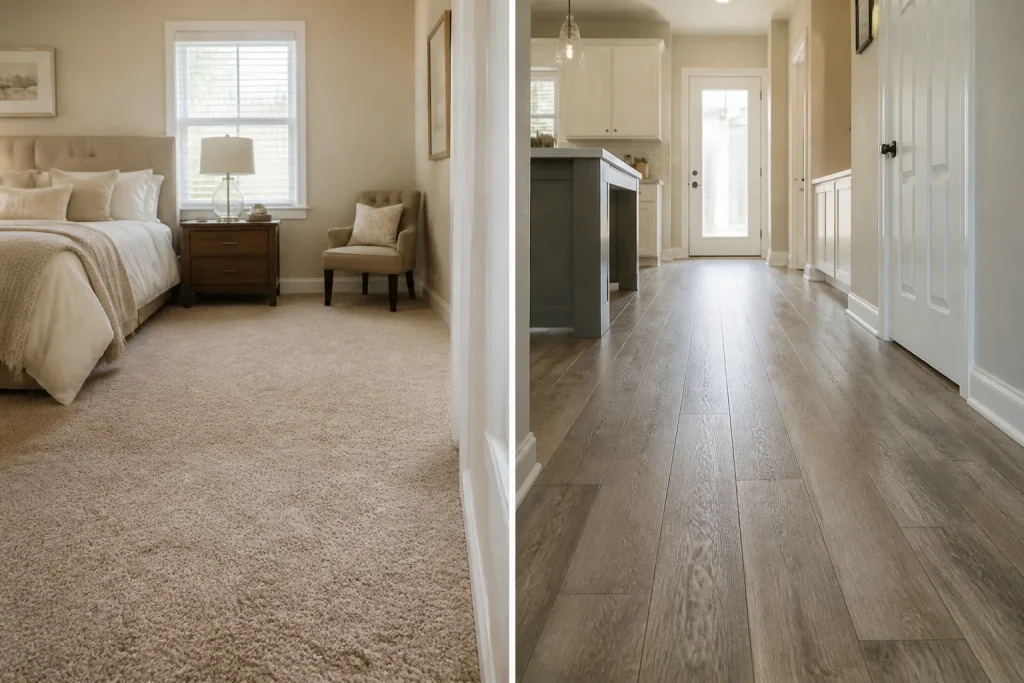
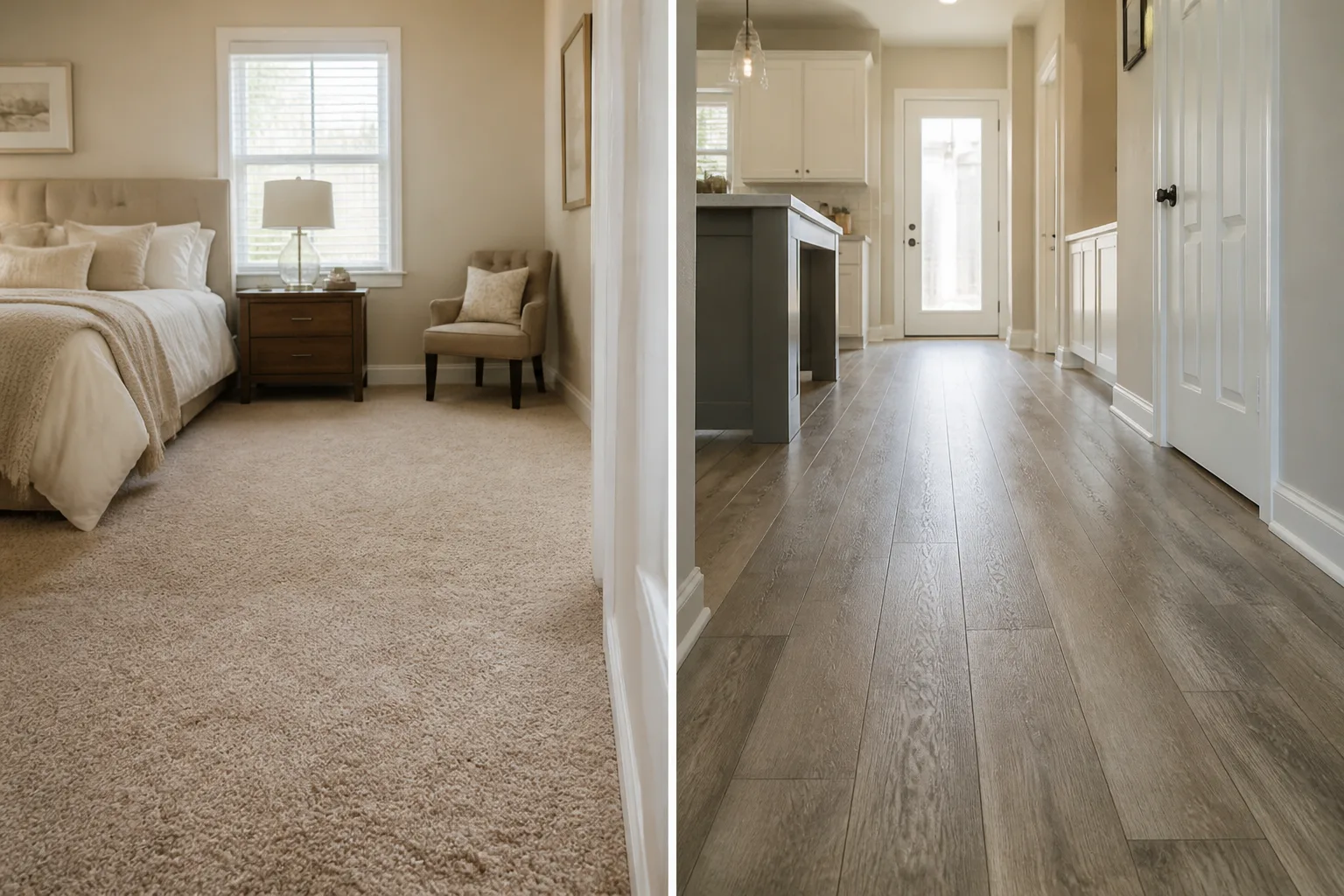
Carpet or Hard Flooring for a Bedroom: How to Decide
Most people pick bedroom flooring by looking at photos, then live with the consequences every night. The better question isn’t which one looks nicer. It’s whether you want a room that absorbs sound and holds onto dust, or a room that reflects sound and keeps dust moving. Carpet and hard flooring behave very differently in a sleeping space, and the right call depends on who sleeps there. Here’s how we think it through.
Does Carpet Really Make Allergies Worse?
The short answer: usually no, and the common logic gets it backwards. Modern carpet made from solution-dyed nylon, like Mohawk’s SmartStrand lines or the pet-focused Stainmaster constructions, traps allergen particles down in the pile instead of letting them drift. Hard floors do the opposite. Dust, pollen, and pet dander settle, then get kicked back into the air every time someone walks across the room, which puts those particles right back at pillow height.
Indoor air quality researchers call this the particle-sink effect. Carpet holds particles until a vacuum pulls them out. A bare hard floor just recycles them.
That advantage depends on the carpet being maintained, though. Three things matter:
- Fiber type. Solution-dyed nylons hold their shape and clean up well because the color runs through the fiber, not just on the surface.
- Pile height. A low-to-medium pile is easier to vacuum thoroughly than a deep shag, which hides more dust but gives it up more slowly.
- Vacuum frequency. Once a week is the floor, twice is better in a bedroom with pets or allergy sufferers.
People with genuine respiratory conditions should still talk to their doctor before deciding. But the blanket idea that carpet equals bad air is a sales pitch, not a rule. At Enterprise Flooring Installation we install both surfaces, so we have no reason to steer you either way.
How Much Quieter Is Carpet in a Two-Story Home?
Carpet with a quality pad is dramatically quieter underfoot and against impact noise, and that matters most in a two-story house where a bedroom sits above a living space. Footsteps, dropped phones, and furniture legs all transmit vibration through the floor structure. Carpet and cushion absorb that energy at the surface instead of passing it down.
Hardwood, tile, and rigid-core vinyl like COREtec or LifeProof all reflect sound. An uncarpeted upstairs bedroom over a hard-floored room below is a classic noise complaint, and the fix is usually either carpet or a substantial acoustic underlayment.
When we quote a carpet install, the pad is the part people want to skip, and it’s the part doing most of the acoustic work. A thicker, denser cushion under even a modest carpet beats a thin pad under an expensive one. In Enterprise, where so many homes are two-story, we treat the pad as a real line item, not padding in the invoice sense.
If sound transmission between floors is your main concern, carpet is the simpler path than adding underlayment and rugs to a hard floor after the fact.
What About Kids and Aging-in-Place Safety?
Carpet is the more forgiving surface for two groups: young children and older adults. It cushions falls, reduces the sting of a stubbed toe, and stays warmer to stand on barefoot in the morning. For a child’s room where roughhousing is standard, or a bedroom used by a parent or grandparent, that cushioning is a real safety feature, not a soft selling point.
The spec that matters is the padding. A denser, thicker cushion absorbs impact far better than a thin bonded pad, and the install matters as much as the product. Carpet that’s stretched properly over a good cushion stays tight and won’t ripple underfoot, which is itself a trip hazard.
Hard flooring has its place for these occupants too. For someone using a walker or wheelchair, a firm, low-pile carpet or a smooth hard floor is easier to move across than a thick plush pile. The point is to match the surface to how the room will actually be used, not pick a material by habit.
Our technicians have up to 12 years of experience installing both, and they’ll tell you plainly when a safety concern should override a style preference.
Which Is Actually Less Maintenance?
Neither is maintenance-free, and the sales process tends to gloss over the hard-floor upkeep. Here’s the honest comparison:
- Carpet needs routine vacuuming and periodic professional cleaning. It hides daily dust well, but it also needs those cleaning cycles to stay healthy, especially in a bedroom.
- Hardwood wants sweeping or dust-mopping and a watchful eye on humidity. It can scratch and dent, and depending on the wear layer, it may eventually need refinishing, which we handle as a service in its own right.
- Luxury vinyl planks like Pergo or LifeProof wipe clean easily and shrug off spills, but they can still scratch, and they aren’t indestructible under heavy furniture.
- Tile is nearly effortless to clean but cold underfoot and hard on dropped objects, which is rarely what you want beside a bed.
The gap narrows when you’re realistic. A hard floor that gets neglected shows scratches and dullness. A carpet that gets neglected shows wear patterns and trapped dust. Each rewards the person who keeps up with it.
Decision Framework by Bedroom Type
The fastest way to decide is to start with who sleeps in the room. Here’s how we break it down for Enterprise homeowners planning a mixed-material project:
- Primary suite. Most people want warmth and quiet here. Carpet with a quality pad wins on comfort and sound, though a hard floor with a large rug is a reasonable compromise if you like the look.
- Kids’ room. Carpet earns its keep for cushioning and noise. Choose a low-to-medium pile that cleans up easily from spills and sticky hands.
- Guest room. Low traffic and a comfort priority. Carpet is an easy answer, and a modest budget buys a good result.
- Bonus room or flex space. If the room occasionally doubles as a home office or workout space, a hard surface like COREtec or a water-resistant vinyl holds up better to chairs, equipment, and moisture. Carpet suits it if it’s mostly a lounge or sleeping space.
Mixed-material projects are common, and it helps to have one installer who handles all three surfaces rather than juggling separate trades for each room. Hard surface, soft surface, or natural wood, we install all of them.
When to Call a Pro
If you’re weighing carpet against a hard floor, an in-home measure and a written quote is the fastest way to stop guessing. We’ll look at the subfloor, talk through the sound and comfort trade-offs for your house, and give you a written price. Carpet installation and tile flooring installation are scheduled jobs: measure first, quote second, install day last. If your existing hardwood just needs a refresh rather than replacement, refinishing is often the smarter spend.
The Bottom Line
For most bedrooms, the decision comes down to three things: who sleeps there, whether the room sits above another living space, and how much upkeep you’ll actually keep up with. Carpet usually wins on warmth, quiet, and fall cushioning. Hard flooring wins on spills, easy cleaning, and rooms that pull double duty. Choose the surface that fits how the room gets used, not the one that photographs best. If you’re in Enterprise and want a straight answer for your specific room, Enterprise Flooring Installation offers free estimates. We’ll bring the samples, check the subfloor, and write you a clear price. Call (833) 620-6314. We answer 24/7. Fast dispatch from 7am to 7pm, Sunday through Friday.
Related services in Enterprise
We install all three primary surfaces: carpet installation, tile flooring, and hardwood refinishing. If you’re planning more than one room, we can quote the whole project at once.
Frequently Asked Questions
Carpet is generally better for comfort, quiet, and warmth, especially in upstairs bedrooms. Hardwood or LVP is better if you want easy cleaning and the room serves multiple purposes. The right pick depends on who sleeps there and what’s below the room. Call (833) 620-6314 for a free estimate on either surface.
Usually not, and modern carpet can actually reduce airborne particles by trapping them in the pile until you vacuum. The key is proper maintenance and a low-to-medium pile that vacuums thoroughly. If you have a diagnosed respiratory condition, check with your doctor first. For a quote on allergy-friendly carpet, call (833) 620-6314, estimates are free.
Installing carpet with a dense, quality pad upstairs is the simplest fix. It absorbs impact noise at the surface instead of letting it travel through the floor structure to the room below. Carpet almost always outperforms a bare hard floor for this. Call (833) 620-6314 to talk through pad options.
The schedule is set at the estimate visit so it fits your room and prep needs. Most single bedrooms move quickly once we’ve measured and confirmed the subfloor. Call (833) 620-6314 to book your free in-home measure, and we’ll give you a written price and a clear install date.
Written by the team at Enterprise Flooring Installation.
Need Flooring Help?
Call Enterprise Flooring Installation - licensed & insured, with free written estimates in Enterprise.
(833) 620-6314