
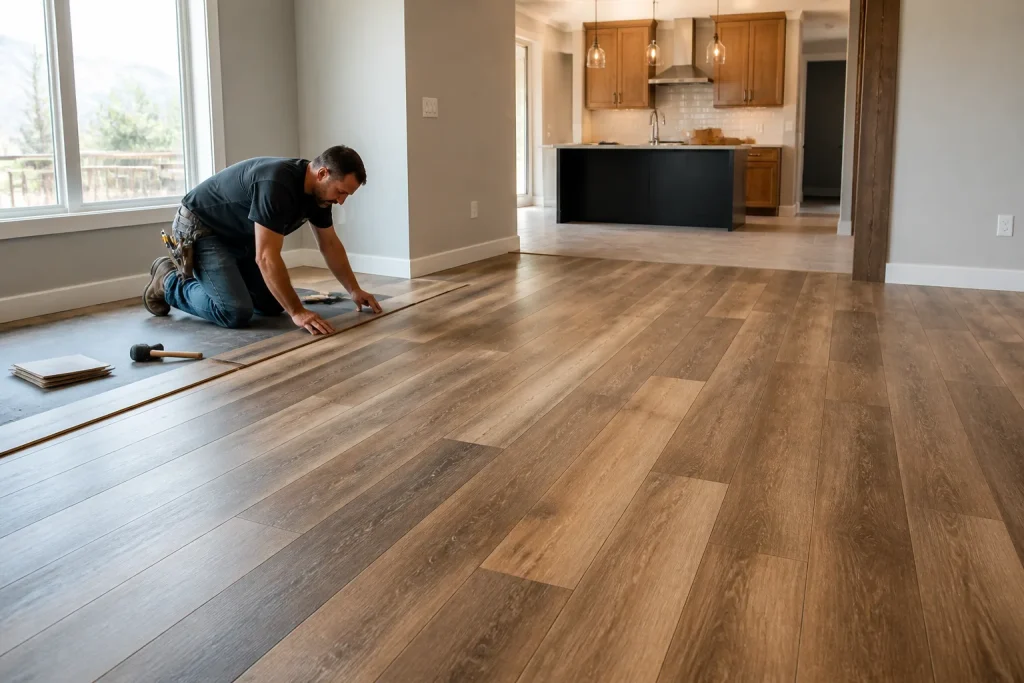

What a Flooring Estimate Should Include
Two estimates can both say “$4.25 per square foot installed” for the same plank floor and still describe completely different jobs. One is written for a room with a level subfloor. The other is written for a room with a hump in the middle that has to be ground down before a single plank goes down. If the estimate doesn’t break out subfloor prep as its own line, you won’t know which job you’ve actually priced until demo day, and that’s when the surprise charge shows up. A real flooring estimate itemizes material, labor, prep, transitions, and disposal, states overage, and puts payment terms in writing.
If reading the fine print isn’t how you want to spend a weekend, call (833) 620-6314 for a free estimate from Enterprise Flooring Installation and we’ll walk you through every line.
What line items belong on a flooring estimate?
A legitimate flooring estimate lists material, labor, subfloor preparation, transitions, and disposal separately, with product names and quantities spelled out. A single lump-sum total hides the parts that change once the floor is opened up. Here’s the list we put in front of every homeowner in Enterprise, and the list you should expect from anyone else.
- Material by product line. Not “vinyl plank” but the actual line and color, with square footage and overage included. The difference matters: LifeProof’s rigid core and a Mannington luxury vinyl are not the same product and don’t cost the same.
- Labor. Installation cost, stated separately from material. Glue-down and floating installs are different labor, and they should be priced as such.
- Subfloor prep as a condition-dependent line. Leveling, grinding, patching, or a moisture barrier, priced as its own item. Prep is the number that moves once the old floor comes out, and a written estimate should say what triggers a change and roughly what it costs.
- Transition strips by type. A doorway threshold, a stair nose, and a T-mold between tile and carpet are three different pieces at three different prices. The estimate should name them.
- Furniture moving and appliance disconnection. Say whether it’s included or not. Guessing at this on install day is a bad way to start.
- Haul-away and disposal. Old carpet, old tile, old padding, and the dumpster to put it in. This is a real cost and it belongs on the page.
- Overage and who keeps the leftover. More on this below, because it’s where estimates quietly disagree.
- Payment schedule and the written warranty terms. Both in writing, before anyone touches a floor.
An estimate missing any of these isn’t necessarily dishonest. It’s just incomplete, and an incomplete estimate is the one that grows.
Why does overage percentage matter on a flooring estimate?
Overage is the extra material ordered beyond the room’s square footage to cover cuts, waste, and future repairs. Ten percent is the standard allowance for a straight-lay installation. Diagonal cuts and herringbone patterns in tile or vinyl plank should carry fifteen percent, because the pattern throws away more material at every edge. The estimate should state the percentage and say who keeps whatever is left.
The math is simple once you see it. A straight-run carpet installation wastes little, and most rooms handle ten percent with material to spare. Lay tile on the diagonal, or run a plank floor in herringbone, and every cut across the pattern produces an off-cut too small to use. That’s fifteen percent, sometimes more on a room with a lot of doorways and corners. An estimate that lists the same overage for both jobs is guessing.
The other half of the question is ownership of the leftovers. Spare planks and a box of tile are worth keeping. They’re the difference between a repair and a replacement if something gets damaged down the road. Ask up front whether the leftover material stays with you or leaves with the installers. Get the answer in writing, because “we’ll leave what’s left” means different things to different crews. In our experience, the estimates that address overage and leftover ownership before the job starts are the ones that don’t produce an argument after.
What language on a flooring estimate should make you pause?
Three phrases on a flooring estimate deserve a second look: “subfloor prep included” with no qualifier, a lump-sum total with no product line named, and an estimate that never mentions moisture testing. Each one hides a cost or a warranty problem inside a number that looks clean.
“Subfloor prep included.” Included up to what? Every subfloor is flat until you pull the old floor and find out it isn’t. A prep line should state what’s covered, what’s not, and what additional prep costs if the floor turns out worse than a walkthrough suggested. Without that qualifier, the contractor has every incentive to call the prep “included” and every reason to add a charge once the floor is up.
Lump-sum totals with no product specified. If the estimate says “$6,200 for the downstairs,” you don’t know if you’re getting the tile you picked at the Daltile display or a builder-grade substitute. A named product line protects you. It also lets you compare two estimates fairly, because you’re comparing the same material.
No mention of moisture testing. Concrete slabs and older subfloors hold moisture, and moisture is what turns a good installation into a call-back. The estimate should say a moisture test will be performed before installation and record the result. It’s a small line item that protects a large purchase.
One more, quieter flag: an estimate that’s suspiciously round. Real prep and real transitions produce real numbers. A figure that ends in three zeros usually means somebody estimated the job from the driveway. We’ve seen enough floors opened up to know that the driveway estimate and the kitchen estimate are rarely the same number.
Why do manufacturer installation requirements belong in writing?
Manufacturer installation requirements, such as a brand’s subfloor flatness specification, should be written into the estimate so there’s a documented record of compliance. Warranty claims hinge on that documentation. If a floor fails and the manufacturer asks whether the subfloor met spec, “the installer said it was fine” is not a record. A written line on the estimate that the prep will meet the manufacturer’s stated tolerance is.
Each brand publishes its own requirements, and they don’t all match. Shaw, Mohawk, and Armstrong each state a flatness tolerance the subfloor has to meet before their product goes down. Those numbers are in the installation guidelines for the specific product, not a general rule for all floors. That’s why the estimate should reference the product by name. “Luxury vinyl installed over prepared subfloor” tells you nothing about whether the prep meets Armstrong’s spec or anyone else’s.
This is where the brand roster matters to the customer. When we install Shaw, Mohawk, COREtec, Pergo, LifeProof, Mannington, Armstrong, Daltile, or Karndean, our technicians work from that manufacturer’s written installation requirements, and we’ll say so on the estimate. Our technicians have up to 12 years of experience, and the first thing that experience teaches is that the documentation protects the homeowner more than anyone. Ask any contractor to put the flatness spec, the moisture test, and the product line in writing before work starts. A pro will do it without complaint.
What should the payment schedule on a flooring estimate look like?
A reasonable flooring payment schedule is a deposit at contract signing, a progress or material-delivery payment, and the balance after installation and a walkthrough. Any estimate that requires full payment before material is delivered is a risk signal, because you’ve handed over the entire job before a single box arrives. The written schedule should be on the estimate, not agreed over the phone later.
The deposit covers the material order and holds your spot on the schedule. It’s normal and it’s expected, since a floor is ordered before it’s installed. What’s not normal is a contractor asking for the full amount up front with nothing delivered and no written schedule. That arrangement leaves you with no leverage and no clear timeline.
Two more details belong in writing alongside the schedule. First, the cancellation and change-order terms: what happens if the material arrives damaged or the room needs more prep than the estimate predicted. Second, the completion walkthrough. The final payment should follow a walkthrough where you look at the floor, check the transitions, and confirm the punch list is done. Ask for that sequence in writing. If a contractor won’t put a payment schedule on the estimate, that’s your signal, and it’s a much cheaper signal to receive now than after the deposit clears.
When should you call a pro instead of comparing estimates yourself?
If you’ve got three estimates and can’t tell which one is honest, or the job involves moisture, leveling, or an older home where the subfloor is a mystery, that’s the point to bring in a professional and get a written breakdown you can actually read. Comparing estimates is work. Understanding what’s missing from them is the harder part.
This matters most on mixed-material projects. Running LifeProof through a kitchen, Daltile on a bathroom floor, and refinishing the hardwood in the hall is three different sets of prep, transitions, and installation methods. A single-trade installer can’t price all three, and a homeowner stitching together three separate estimates can’t see where the seams will show. That’s where a flooring specialist earns the fee. We install and refinish carpet, tile, and hardwood as three distinct services because the trades and the prep differ. Hardwood refinishing also preserves an existing floor that’s still got life in it, which is often the more sensible option than replacing it, and we’ll tell you which applies at the estimate rather than after.
For homeowners in Enterprise and the surrounding neighborhoods, the free estimate is the starting point, not the commitment. Call (833) 620-6314. We answer 24/7. Fast dispatch from 7am to 7pm, Sunday through Friday. A call outside dispatch hours gets booked into the next opening, and the estimate visit comes with a written line-item price.
Related services in Enterprise
If you already know what surface you’re replacing, a free estimate for tile flooring installation or carpet gives you a line-item price to compare against the next contractor’s total.
The Bottom Line
A flooring estimate is a document, and the document tells you how the job will actually go. If it lists material, labor, subfloor prep as its own line, transitions by type, disposal, overage percentage, moisture testing, and a payment schedule, you’re holding a real estimate. If it’s a lump sum with no product line, no prep qualifier, and a request for full payment up front, you’re holding a sales pitch.
Ask these questions of any estimate, including ours:
- Is subfloor prep a separate line, and what changes if the floor comes up worse than expected?
- What overage percentage applies, and who keeps the leftover material?
- Which product line and SKU are specified?
- Will moisture be tested before installation, and will the result be recorded?
- Does the estimate reference the manufacturer’s flatness specification for this product?
- What’s the payment schedule, and does the final payment follow a walkthrough?
If you’re in Enterprise and need help, Enterprise Flooring Installation offers free estimates. We install and refinish carpet, tile, and hardwood, and we install Shaw, Mohawk, COREtec, Pergo, LifeProof, Mannington, Armstrong, Daltile, and Karndean. Nine trusted brands, one installation crew, and a written estimate with every line visible. Call (833) 620-6314 to schedule yours.
Frequently Asked Questions
A flooring estimate should include material by product line, labor, subfloor prep as a separate condition-dependent charge, transition strips by type, furniture moving, haul-away and disposal, overage percentage, moisture testing, and a written payment schedule. Any of those missing is a line that can grow after the old floor comes out. Call (833) 620-6314 for a free line-item estimate and we’ll show you exactly what’s covered.
Ten percent is the standard overage for most straight-lay installations, and fifteen percent is appropriate for diagonal tile or herringbone plank patterns. The estimate should state the percentage and say whether leftover material stays with you. Overage protects against cuts, waste, and future repairs, so confirm it in writing before work starts. Call (833) 620-6314 for an exact quote, and the overage will be spelled out in it.
No. A reasonable schedule is a deposit at signing, a progress or material-delivery payment, and the balance after installation and a walkthrough. Requiring full payment before material is delivered is a risk signal. Ask for the schedule in writing. Call (833) 620-6314 with any questions, and we’ll walk you through how our estimates are structured.
Because a dry-looking slab can still hold enough moisture to compromise an installation, and the only way to know is to test. Moisture testing belongs on the estimate as a stated step before installation. If an estimate never mentions it, ask why. Call (833) 620-6314 for an estimate that documents the moisture test and the manufacturer’s flatness requirement for the product you choose.
Written by the team at Enterprise Flooring Installation.
Need Flooring Help?
Call Enterprise Flooring Installation - licensed & insured, with free written estimates in Enterprise.
(833) 620-6314